

Solutions
EMERGENCY DEPARTMENT PROGRAM
Words that heal
In moments of reproductive loss, patients don’t just remember what happened; they remember what was said, and how they were treated. Decades later, those words are still with them.
Each year, 900,000 patients seek care for early pregnancy loss in the emergency department, yet too many leave feeling unseen, unsupported, and alone.
We equip your team to deliver words that heal, not harm.
We prepare your team to deliver words that heal, not harm.

THE BUSINESS CASE
Compassionate care shows up in the metrics you already report
Reproductive loss care is not a soft initiative sitting outside the numbers. It touches four measures nursing leadership is already accountable for.
PATIENT EXPERIENCE
of the CMS Value Based Purchasing score is patient experience. Hospitals with excellent ratings earn net margins of 4.7 percent, versus 1.8 percent for low rated peers.
25%
RISK
of malpractice communication cases now involve provider to patient failures, the fastest growing category. Communication is a factor in 40 percent of all claims.
63%
WORKFORCE
is what each percentage point of RN turnover costs the average hospital every year, and $60,090 walks out with every RN departure.
$295,000
LOYALTY
of household healthcare decisions are made by women. How a loss is handled decides where a family delivers next, and where they seek care after that.
80%
PEER REVIEWED
The training measurably changes how care is delivered
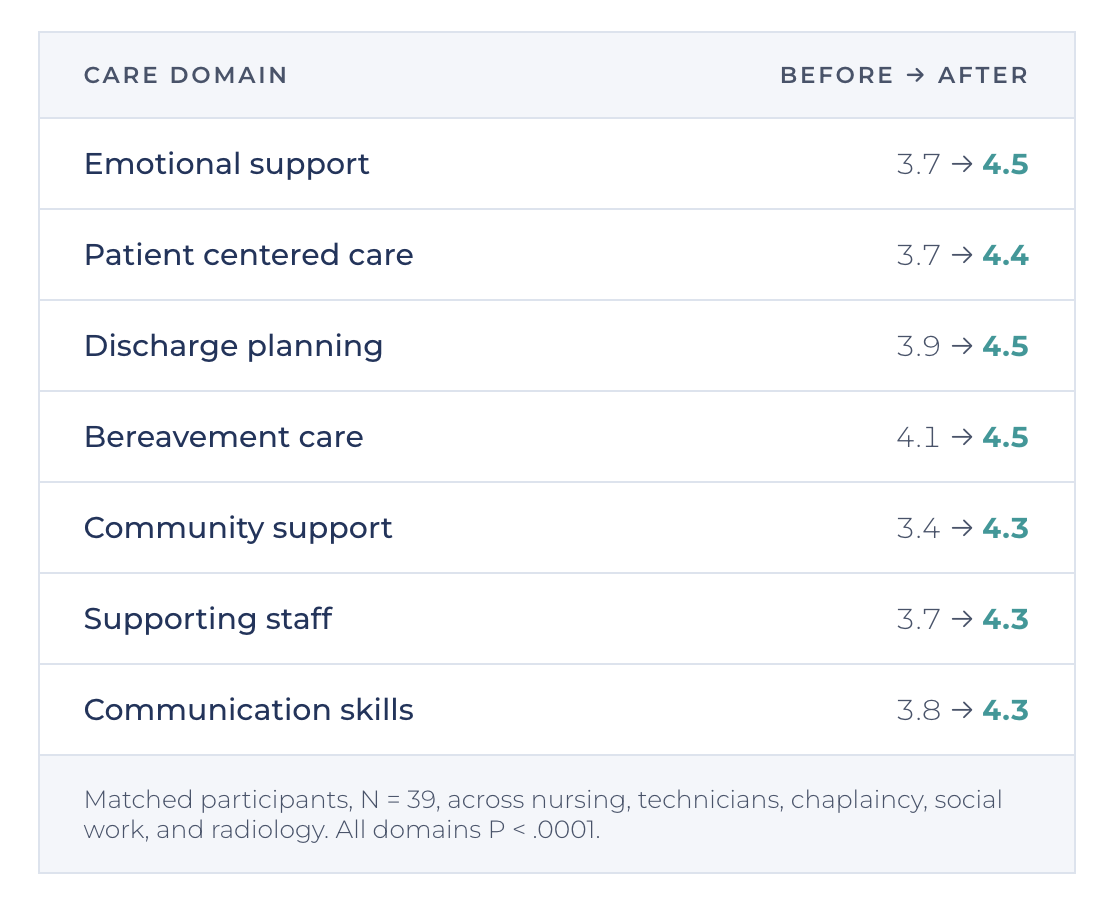
Our emergency department program was implemented across two large urban emergency departments and studied pre and post intervention. Staff knowledge, attitudes, and supportive care skills improved across all seven domains measured, and every result was statistically significant.
The findings were published in the Journal of Emergency Nursing in January 2026.

A Structured Approach to Compassionate Care
We partner with hospitals to close the gap between clinical care and compassionate support by:
Identifying gaps in training and care delivery.
Strengthening policies and protocols.
Equipping multidisciplinary teams with evidence-based, trauma-informed education.
WHAT YOUR TEAM GAINS

Skills that transfer beyond the loss
Best practices for reproductive grief care, grounded in evidence and real world application
Preparation for high stakes conversations, including delivering difficult news
Trauma informed and grief care skills that carry into every hard encounter, not only pregnancy loss
Compassion fatigue and resilience practices that protect the staff doing the work
Ongoing education and reinforcement, so consistency holds as your team changes

Train-the-Trainer Program
We empower your team leads to train, reinforce, and scale reproductive grief care practices across your organization, ensuring consistent, compassionate care across every interaction.
RECOGNITION
The Compassionate Care Designation
A formal recognition that your organization delivers consistent, compassionate support during one of the hardest experiences a family will face. It signals to patients, staff, and your community that this is a standard you hold, not an intention you state.
Recognition as a leader in compassionate, whole-person care
A clear, structured approach to supporting patients experiencing loss
Increased confidence and alignment across your staff
Meaningful differentiation in your community
“There’s a level of efficiency expected in healthcare, but sometimes it comes at a cost. It doesn’t have to. The Institute’s programs are aligned with what truly works.”
Dr. Kristen Lipari, PhD
Post Partum Health Alliance
NEXT STEP
Tell us about your department and we will follow up to schedule a short call. Nothing to prepare, and nothing to review in advance. We will walk you through what the program looks like in a department like yours, and what it would take to run it.
Not ready to talk? Take the two page ROI brief and share it with your team first.